

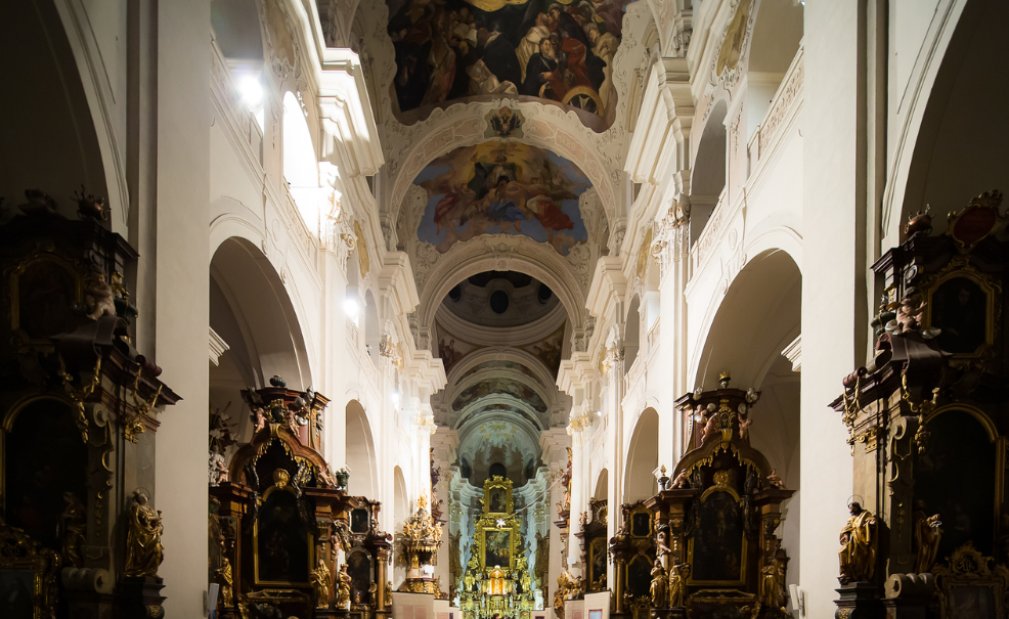
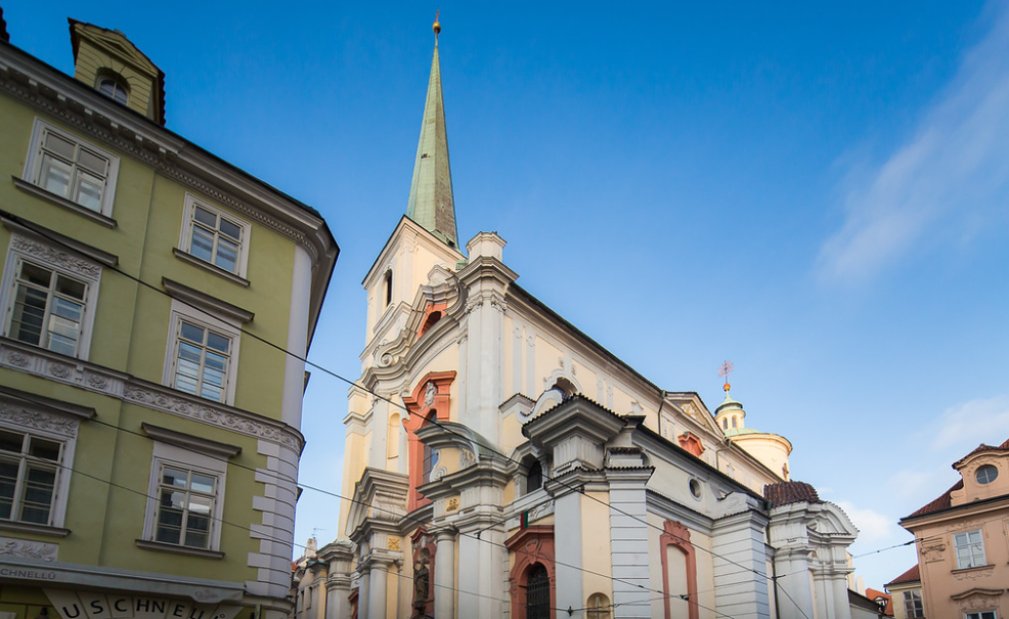
St. Thomas Church brings occasional concerts into a richly decorated Baroque interior shaped by medieval foundations and more than seven centuries of Augustinian history.
Standing on Josefská Street near Malostranské náměstí, the church remains part of an active Augustinian monastery and Roman Catholic parish. Its slender octagonal tower is a familiar feature of the Lesser Town skyline, while the interior brings together medieval fabric, monumental Baroque frescoes, sculpture and altars.
From a Gothic church to a Baroque landmark
King Wenceslas II established the Augustinian monastery here in 1285, beside an older, probably Romanesque church. The new Gothic church was completed in 1379. It was damaged during the Hussite wars but remained one of the few Catholic churches in Prague. Later restoration introduced Renaissance portals and furnishings.
After a lightning strike caused a fire in 1723, the reconstruction of 1727–1731 was entrusted to Kilián Ignác Dientzenhofer. Rather than replace the medieval building, he retained its ground plan and Renaissance portals while reshaping the façade, vaults and domed chancel. This transformation gave the church its present Baroque character.
Reiner’s frescoes and Rubens at the high altar
Václav Vavřinec Reiner covered the nave and chancel ceilings with scenes from the lives of St. Augustine and St. Thomas. In the dome, Christ and St. Thomas appear with the apostles, framed by allegories of the continents.
The high altar, also designed by Dientzenhofer, combines sculpture by Jan Antonín Quitainer and Ferdinand Maximilian Brokoff with copies of two altar paintings created by Peter Paul Rubens for the church in 1637. The originals are now held by the National Gallery Prague. Additional paintings by Bartholomeus Spranger and Karel Škréta complete the ensemble.
A living Augustinian church
The Augustinians still serve the parish, whose congregation includes Czech and international communities. Regular worship continues in several languages, while occasional sacred, choral and chamber concerts form part of the church’s cultural life. The building remains both an exceptional historic interior and a living place of worship.