

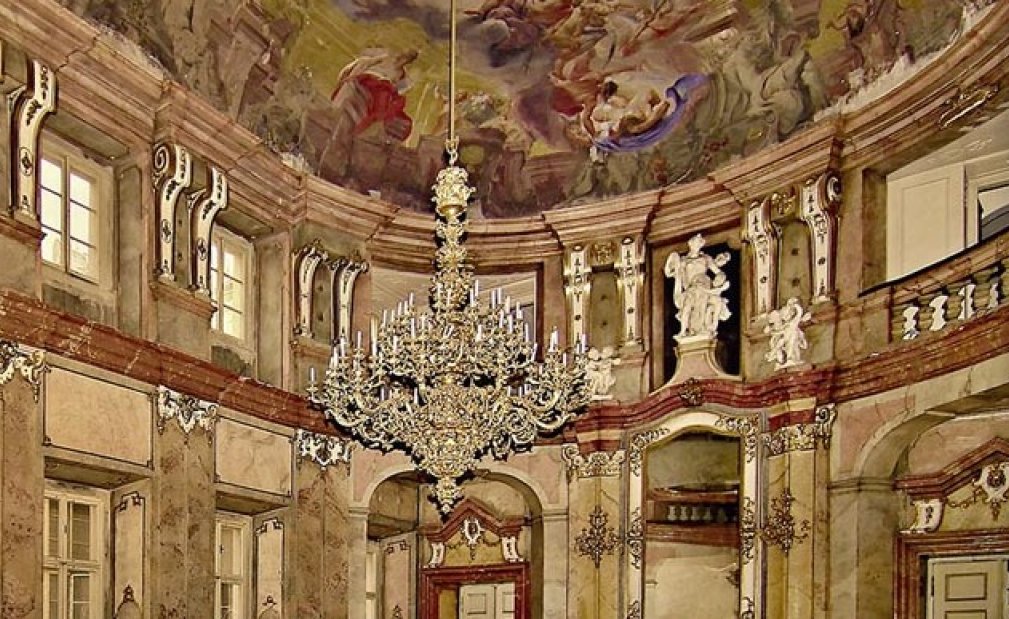
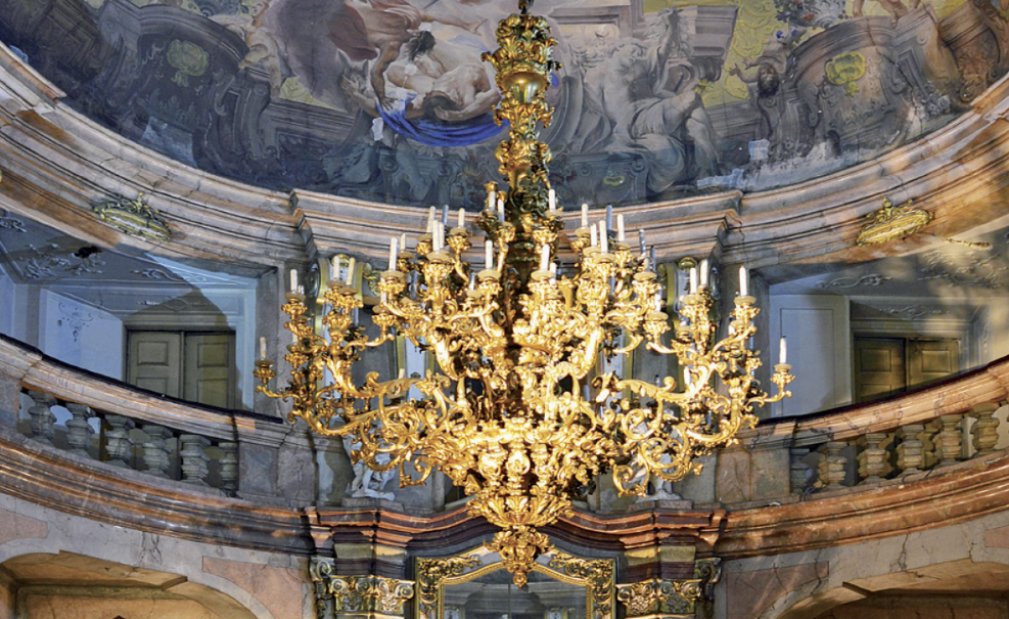
Beside Charles Bridge, Colloredo-Mansfeld Palace preserves one of Prague’s most remarkable Baroque interiors: a dance hall crowned by an unrestored 18th-century ceiling fresco.
Standing at Karlova 189/2 on the Old Town side of the bridge, the four-winged palace brings together medieval foundations, a Renaissance residence, High Baroque architecture and later Rococo interiors. Today it is managed by Prague City Gallery.
From medieval houses to a High Baroque palace
The palace developed over Romanesque and Gothic buildings and a Renaissance house. In 1736–1737, Prince Heinrich Paul von Mansfeld-Fondi commissioned architect František Ignác Prée to reshape the residence in the High Baroque style, following an earlier concept traditionally attributed to Giovanni Battista Alliprandi.
The result is a four-winged complex around a narrow courtyard, with a monumental entrance on Karlova Street. Rococo and later Neo-Rococo alterations added further layers without erasing the Baroque character of the principal rooms.
The Baroque Dance Hall
The palace’s best-preserved interior is its Dance Hall. The decoration was probably completed in 1736–1737. Pietro Scotti painted an assembly of the Olympian gods on the ceiling, while Giovanni Battista Zeist created the illusionistic architectural setting.
The fresco was never repaired after its creation, leaving the artist’s original hand unusually legible. The richly ornamented hall has also served as a setting for music and cultural events.
From noble residence to city gallery
Over the centuries, the palace passed through the hands of several aristocratic families. After the Second World War, it was used by the Czechoslovak Academy of Sciences; Prague City Gallery took over its management in 2010 and opened the representative interiors to the public in 2013.
One of the palace’s rooms appeared in Miloš Forman’s Amadeus. Its layered interiors preserve visible traces of different periods rather than presenting a polished historical reconstruction.
Upcoming concerts at this venue
There are currently no upcoming concerts scheduled at this venue.
Browse all concerts